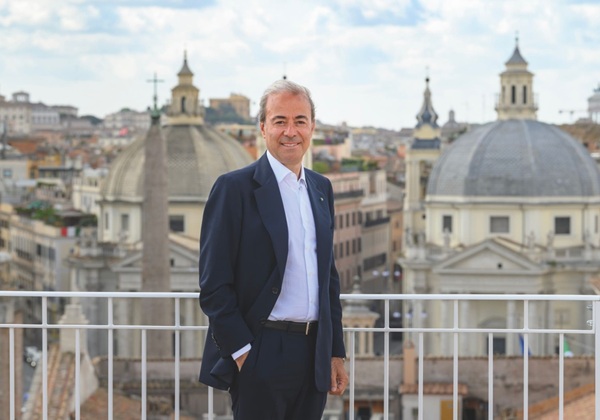
From June 17 to 19, Rome hosted the FII Priority Europe 2026, the European summit of the FII Institute bringing together investors, policymakers, entrepreneurs and major industrial groups to discuss infrastructure, energy, technology, manufacturing and finance. Among the participants, Alessandro Albano, President of Equiter S.p.A. and Fondazione CERM, took part in the Capital Deployment Lab “Mobility & Infrastructure Corridors”, a session focused on investments in mobility and infrastructure corridors and on how different actors can coordinate financing, regulation and technology to make these large-scale works resilient and economically fair in their impact.
The session addressed how mobility and infrastructure corridors are reshaping trade, investment flows and regional development, adding that as global capital seeks long-term opportunities, the ability to connect infrastructure, sustainability and economic growth will become a key differentiator. In his speech, Alessandro Albano argued that infrastructure is too often assessed only through capital expenditure, financing needs and asset performance. “Today – he said – infrastructure should not be evaluated solely by the number of kilometres built, the volume of traffic generated, or the financial returns it produces. Its true value lies in its ability to transform territories and create long-term economic opportunities”. According to him, the most successful infrastructure projects are those that attract talent, innovation, entrepreneurship and additional investment: an airport, a railway corridor, a logistics platform, a port or an energy network should be seen not as a standalone asset, but as the enabler of an ecosystem. The key question, he said, is no longer simply what return an infrastructure generates, but what kind of ecosystem it will create, whether it will attract skilled people, foster innovation, generate new businesses and industries, and strengthen a region’s connection to global markets.
“We often hear that the world suffers from a lack of capital available for infrastructure investment – he added – I do not think this is the real issue”. Global markets are rich in capital, with sovereign wealth funds, pension funds, infrastructure funds, development institutions and private investors all seeking long-term opportunities with sustainable returns. The real problem, according to him, is a shortage of what he called “bankable ecosystems”: “Investors do not invest only in physical assets. They invest in environments that offer confidence, predictability, and long-term growth potential. Countries seeking to attract significant investment flows must therefore focus on creating bankable ecosystems”. Countries seeking to attract significant investment flows must focus on political and institutional stability, transparent and predictable regulation, efficient governance, commitment to execution, and a clear long-term vision of how infrastructure fits within a broader development strategy. For Alessandro Albano, capital follows vision: when investors understand a country’s direction, when institutions are credible and when infrastructure projects are embedded in a coherent economic strategy, capital becomes available. The countries that will succeed in the coming decades will not necessarily be those that spend the most on infrastructure, but those that use it as a catalyst for economic transformation, talent attraction, innovation and sustainable growth. “Infrastructure is not merely about connecting places. It is about creating the conditions for prosperity – he concluded – And prosperity is ultimately built not only through projects, but through ecosystems”.